Assembly Required.
- Stay Connected
- Subscribe to our newsletter for updates and exclusive content
Signed. Not Stamped.
There’s a certain hush that falls over a good script logo. It doesn’t shout; it leans in. The line moves like a wrist, not a ruler, breathing a little, wavering a little, alive. In a world built on grids and pixels, that gesture feels human. And the eye, ancient thing that it is, loves the trace of a hand.
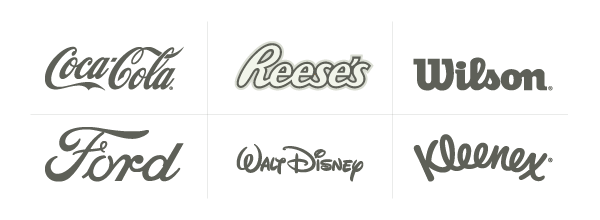
Consider the familiar cursive of Coca-Cola or the honeyed swoop of Reese’s. Ford’s oval holds a name that still feels signed rather than stamped. Kellogg’s loops like a breakfast-table autograph. Wilson arcs with the confidence of a ballplayer’s flourish. Each mark carries a rhythm you can almost hear. The speed changes, the pressure shifts, the brief lift between letters. These are not just shapes; they’re recorded motion. A thing of beauty.
We’re drawn to that motion because our brains are wired for bodies. A script logo preserves the choreography of writing—the acceleration into a curve, the deceleration into a terminal. It signals presence. Someone was here. Someone cared enough to make this line beautiful.
Even when digitized and infinitely reproduced, the original human gesture persists, like a fingerprint in lacquer.
There’s history in those strokes, too. Modern cursive took a decisive turn in the 15th-century Italian Renaissance with Italic script (faster, slanted, economical, suited to the flow of thought across paper). Centuries later in America, the Spencerian and Palmer methods standardized that elegance for everyday use, teaching generations to write with grace at speed. Today’s great script logos are heirs to that lineage: commercial, yes, but also cultural. They’re tiny monuments to penmanship.
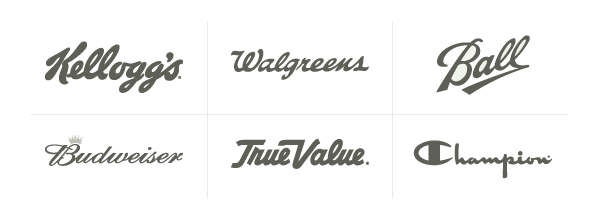
Designers talk about warmth, approachability, trust. Script delivers all three without a word of copy. It feels signed because it is signed. By tradition, by motion, by the enduring idea that a line can carry a life. And when the eye meets that line, it recognizes itself: not a machine parsing geometry, but a human following a hand.
